
As promised, here is the next round of the window process (see Part I, here).
This post covers steps 4-6:
4) Remove all of the old paint and window glazing putty from the de-glassed window sashes.
5) Using wood epoxy liquid and compound, restore the integrity to any damaged/soft/rotting wood.
6) Sand the cleaned and repaired sashes and dry-fit the glass.
At the outset, I need to send a big thanks out to Nancy and Comer, who loaned me their copy of Working Windows by Terry Meany, an excellent resource with over 200 pages of window advice. Where was this when I started out?!
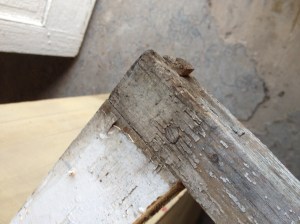
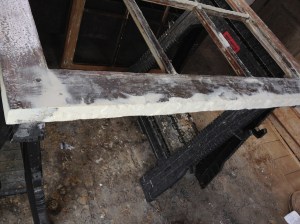
Down to business. When I last left you, I had gotten the glass out of the windows, but the frames were untouched. Untouched, aside from 200 years of Mother Nature hammering away with all she had. This left the frames in pretty poor shape: 
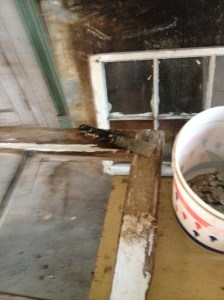
OMG! This window was actually one of the worst, thank goodness, but it is a good example and really covers all of the bases when it comes to restoration requirements. As shown above, this window had severe rot, and as shown below, the wooden pins were coming out of the mortise and tenons:

Additionally, the joints were deteriorating and had whole pieces missing.
The first step in the process was to remove all of the old paint and any remaining putty to be able to really see what I was working with. First, I went to Lowes and got paint stripper; that’s basic, right? Wrong. I tried both of the brands they offered, and both wound up with me just scraping at the paint and trying not go gouge the wood.
Next step: Amazon. I’ve found that when I don’t know how to best tackle a product, the reviews on Amazon can generally point you in the right direction. I searched and searched, and kept coming back to one product, Soygel, which (*bonus*) is soy-based! No awful toxic mess. But, it was about three times the price…this soy stuff better be good. I got just one quart to start out. In reading the reviews, everyone noted that there are no miracles; Soygel works best over about 24 hours of setting in, not right away. Additionally, some reviewers noted that covering the Soygel with plastic wrap prevents evaporation and makes it work “better.” My scientist side again comes out! I tried putting it on thin, thick, covered thin, and covered thick.
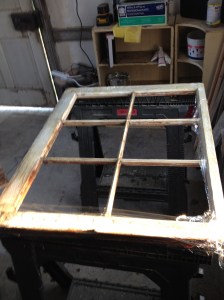
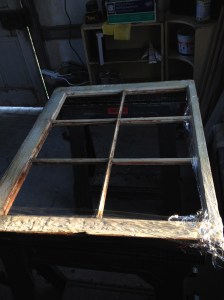

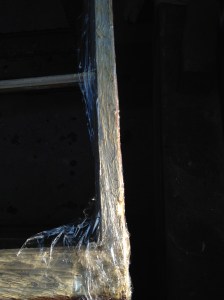
Regardless, it all came off like this!
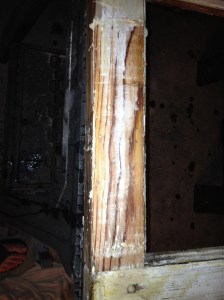
There was still a little scraping and clean up to, but I was able to get most of the paint off…for residuals, I employed the heat gun (again, in full respirator mask), which seems to work on the stubborn areas where the Soygel doesn’t help, or, if you don’t have the 24-hour lead time!
Next, I had to tackle the parts of the wooden frames that went sans paint for a decade (or four). The weathered wood was particularly spongy, especially on the muntins where moisture had seeped behind the putty and was trapped there, providing the perfect mold and insect habitat. Enter the rehab tools. Abatron makes my “products of choice” list for historic restoration projects, and is noted in Working Windows. Though the stuff can be a little expensive, it works miracles:

Pictured above are Abatron’s LiquidWood and WoodEpox, and some denatured alcohol, which is the universal solvent for these products. They both come in two parts that only activate when they are mixed together. The LiquidWood infiltrates the voids that develop in the wood through the rot process and solidifies there, reinforcing the structural integrity of the wood, and it doesn’t rot any further! When I’m tackling a couple of windows, I thoroughly mix a good amount in a clear condiment bottle (I bought 12 off of Ebay for $7.00); the squirt nozzle allows you to apply the LiquidWood right where you need it and not make a mess of things.

Once the LiquidWood is on the desired surface, I use a paint brush to apply it evenly and ensure full penetration. LiquidWood, however, is just for where the wood is weathered or slightly “spongy.” For the parts where the wood has already rotted off or where voids, insect boreholes, or breakages have occurred, you need the big guns: WoodEpox. To start out, you again mix equal parts, but this time it’s like play-dough!

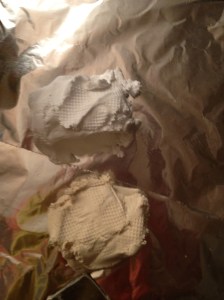
Once it is all mixed together, I prime the target surface with LiquidWood, which infiltrates down into the base, the wood around the areas is usually pretty bad itself, and then I slather on the WoodEpoxy. I have found that the denatured alcohol makes this product a lot easier to work with and helps keep it from sticking to your gloves, etc., while you are applying it.

It is important to put on more than you really need, because once it is all dry, you sand it down to get the profile and surface you want; if you skimp you might find yourself having to go back and add more – a real pain due to the drying time required.

Once it is done, it has to set for a couple of days.
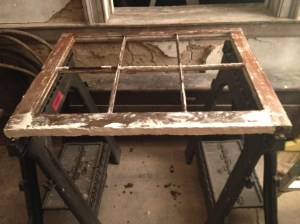

And when it is dry, you just sand it down until it is flush with the existing frame. Voila!

Muntins and rabbits are particularly tricky; again, the key is to put on more than you need and sand down when it is dry.

All trimmed down!

After it has set thoroughly, I sand the wood all over one last time to ensure that the surface is smo0th and free of imperfections. After sanding, I take each piece of glass and dry-fit it back into the frame. This process is essential to do before you add putty, as you don’t want to try and force the glass into the frames, and the dimensions have changed since the muntins have been restored with putty. I found that this step took extra time with the sander to ensure that each piece of window glass had a nice snug fit.
Next up, window putty! Or, the process of separating the men from the boys.
 Living on the Edge(Hill)